Namaeh Farhangistan

Namaeh Farhangistan

Journal Archive

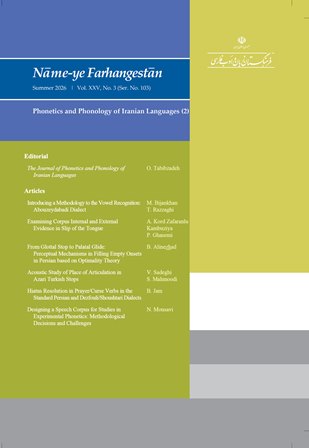
Nameh Farhangestan (Phonetics and phonology of Iranian languages ​​2)
Nemeh Farhangestan (Comparative Literature)
Nameh Farhangestan (Grammar)


It informs the respected authors that Nama Farhangistan magazine will be published bimonthly from 1403.

Respected authors can submit their articles in the following topics:

grammar, comparative literature, literary research, vocabulary studies, Iranian languages ​​and dialects, subcontinent, Asia Minor, lexicography, Persian language education, Islamic revolution literature, Phonetics and Phonology of Iranian Languages

Send to the address of the same system.

Before preparing and submitting an article, please read the "Authors' Guide" section of the system carefully and prepare the article in the same way and send it to the publishing office through this system. The articles should be sent in Word and PDF files. The bimonthly is not allowed to accept articles that are outside this structure. It is mandatory to send the commitment and conflict sheets signed by the authors along with the article.

The Academy's letter is published in cooperation with the Association for the Promotion of Persian Language and Literature of Iran with a grade of (B).

Average initial review time: 10 days
Average review time for articles: 3 months
Type of review: Two-way anonymous
Allowed percentage of similarity in articles: 15%
Latest evaluation rank (ISC): Q4
Impact factor: 0.038

Dear authors, before submitting the article, use the Samim Noor similarity finder and send the confirmation in PDF format

The journal receives 400,000 Tomans for refereeing articles and 400,000 Tomans for printing articles. Authors should deposit their amount to IR420100004001003103004797 and deposit ID 364003174101022008866228586256.

Dear authors, please follow the article through your personal page in the system and call 88642362 if needed.

Correspondent of the magazine: namehfarhangestan@gmail.com

Address of the journal office: Shahid Haqqani highway, National Library exit, Dr. Hassan Habibi Boulevard, Persian Language and Literature Academy. Postal code: 1538633111

Website: www.apll.ir

Farhangistan Persian Language and Literature follows the rules of COPE publishing ethics. https://publicationethics.org/

Keywords Cloud

  • Iran
  • Ottoman
  • Lexicography
  • Persian language
  • Iranian languages
  • etymology
  • Rumi
  • contemporary poetry
  • comparative literature
  • translation
  • Khaqani
  • Novel
  • myth
  • Calligraphy
  • middle Persian
  • dictionary
  • Manuscript
  • spoken persian
  • Shahnameh
  • Arabic Poetry
  • Semiotics
  • Khaqani Shervani
  • Textual Criticism
  • brokerage
  • Vault
  • Linguistics
  • Consulate General
  • Alai Darwaza
  • Constantinople
  • Dome
  • Azerbaijan
  • colloquial language
  • Historiography
  • Quwwat al-Islam
  • Constantine
  • Ismail Farzaneh
  • Qajar
  • literary influence
  • narrative
  • Divan
  • Persian poetry
  • Colloquial Persian
  • Persian
  • Monsieur Koleh
  • popular literature
  • Indian Subcontinent
  • Plant
  • grammar
  • Persian Grammar
  • Greater Khorasan
  • language
  • Idris Badlisi
  • Phenomenology
  • Rhyme
  • Ottoman Empire
  • Byzantine Empire
  • Hagia Sophia
  • Khaghani
  • love
  • Arabic Literature
  • The manuscript from 537 AH
  • Majmaʿ al-Nafāʾis
  • Painting
  • Extrospective Narrative
  • classical Persian texts
  • perceptual role
  • slang dictionary
  • Abulfazl al-Meybodi
  • Onomasiology
  • Anatolia (Asia Minor)
  • Ali Ravāghi
  • \"
  • Masnavi Manavi
  • kaštī-ye ʿarūs
  • Safāhāniyya
  • Event verb
  • Ottoman Turkish
  • Hiatus
  • book of questions
  • Rāhat al-Sudūr wa Āyat al-Surūr
  • Bosnia and Herzegovina
  • Ajayebnameh
  • Phrasal weight
  • garde
  • Takye system: metrical structure: bilingualism: Persian language
  • Arabic in Persian
  • Informal Writing
  • Sultan Muhammad Fatih
  • Letter, soil-sprinkling, throwing letters on the ground, Persian literature, letter-writing rituals
  • Sixth century AH
  • literary translation
  • Armenian
  • dialectology
  • Parizad
  • subcontinent
  • : Persian classical texts
  • Shafarvah
  • allusion
  • Persian suffixes؛ word-formation؛ -kade؛ Khaqani؛ Sana&rsquo
  • present imperative
  • noun clause
  • Resistance Literature
  • Persian literature in India
  • conversational lyricism
  • Ottoman citizens
  • Church Music
  • Functional category
  • Abivardi
  • Literature
  • Minimal pair
  • Shahnameh of Suleiman
  • Speech elicitation
  • culture of Persian language and literature
  • Ologh-Beik
  • Auditory dispersion theory
  • zādmarg
  • Khāqāni Sharvani
  • modelling
  • Coleman Barks
  • Eulogist (Manāqib-khwān)
  • Sistani scribe
  • corpus linguistics
  • سؤال بلاغی
  • Specificity
  • Golpinarli
  • Persian script
  • Meaning-making
  • corpus external evidence
  • Speech segmentation
  • Santūr
  • Aufi’s Jawami ul-Hikayat
  • Narrator
  • Syriac
  • imperfective aspect
  • intrarlinguistic motivation
  • The Pilgrim\'s Progress
  • Arzanat Al-Rum
  • children’s poetry
  • Tuhfeh-ye Ala\'i
  • interpretations
  • medical humanities
  • Abouzeydabadi
  • Language game
  • 19th-century European literature
  • rule of poetic meter derivation
  • Resaleh-ye Qafiyeh
  • correction
  • stylistic layers
  • literary sophistication
  • Turan
  • Makhzan al-Asrār
  • Abulmaḥāsin Ḥusayn ibn Ḥasan J̌urǰānī
  • deconstruction
  • preposition ‘mar’
  • گفتمان عرفانی
  • Bundahishn
  • lithographic printing of Khaqani Shervani’s Divan
  • s skull, drinking from someone&rsquo
  • Simin Daneshvar
  • Farhang-e Bozorg-e Sokhan
  • evolution of meters
  • categorization of Persian poetic meters
  • structural links
  • Al-Sami fi al-Asami
  • Shakespeare
  • Mehdi Akhavan-Sales
  • \"hast\"
  • syllable onset filler
  • lexicography: old Persian translations of the Quran: old Arabic-Persian dictionaries: Persian dictionaries in the Indian subcontinent
  • lexical layer
  • adopted terms
  • Iranian and Ottoman language connection
  • Stylist
  • Digital Humanities
  • Tafsir of Kitabullah
  • Kamran Mirza
  • Spirituality
  • wandering quatrains
  • Symbol
  • Fairy
  • Consecutive prepositions
  • approved script
  • marked words
  • Hāfiz
  • Judeo-Christian account of the flood
  • Ghatrān Tabrizi’s poems
  • Safavid
  • war
  • Middle Farsi
  • Ottoman rule
  • Translation techniques
  • conjectural emendation
  • old Persian political view
  • Afrasiab
  • Speech corpus
  • Kashmiri criminal
  • Ovid
  • literary taste in Rāvandi’s era
  • Negotiations Reports
  • Abul Fazl Ahmad bin Muhammad al-Midani