Namaeh Farhangistan

Namaeh Farhangistan

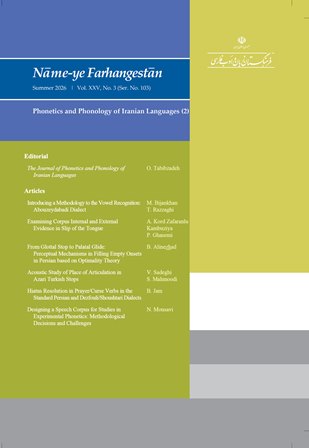
Introducing a Methodology to the Vowel Recognition: Abouzeydabadi Dialect

Document Type : Original Article

Authors
1 Professor, Department of Linguistics, Faculty of Literature and Humanities, University of Tehran, Tehran, Iran
2 Persian Language and Literature, Faculty of Literature, Islamic Azad University, Najafabad Branch, Iran
10.22034/nf.2026.551804.1473
Abstract
The main aim of this article is to introduce a phonetic and phonological methodology to recognize vowels from speech data of an informant belonging to a dialect region. To this end, Abouzeydabadi dialect is chosen because of its richness in vowel variations. Given the prediction of the auditory dispersion theory, a native speaker of Abouzeydabadi was asked to produce appropriate minimal pairs in interaction with the researcher. Audio and video of the speech data were recorded. Distinctive vowels and their corresponding symbols, according to cardinal vowels trapezoid, were identified cautiously by investigating first, second and third formants, acoustic rules governing them and observing lips shape. The process extended from universal vowel triangle to vowel polygons until 15 Abouzeydabadi vowels were recognized, 12 of which were short and 3 were long. In general, lip shape, tongue root position, centrality and length have led to the extension of the vowels in Abouzeydabadi. Minimal n-tuplets and formant frequencies illustrate that lip shape is distinctive for close front and mid front vowels. In addition, advanced and retracted root of tongue contrast for close front vowel. Low central vowel [ɐ] and round mid central vowel [ɵ] are among most frequent central vowels in our research data. Evidence was also obtained for the phonological function of length for the central vowels [ɵː] and [ɐː] and the vowel [eː].
Keywords
Subjects

References
Sources are in Persian unless otherwise specified.
Barati, Gholam-Reza (2020), Razhi Dictionary (An Ancient Iranian Dialect in Southeastern Kashan), Tehran, Jahad-e Daneshgahi (Shahid Beheshti Branch).
Bijankhan, Mahmoud (1995, PhD dissertation), “Phonological and Phonetic Representation of Persian Language and Its Application in Speech Recognition”, Y. Samareh (ed.), Faculty of Literature and Humanities, University of Tehran.
________ (2005), Phonology (Optimality Theory), Tehran, SAMT.
________ (2016), Phonetic System of the Persian Language, Tehran, SAMT.
Mazre’ati, Abbass et al. (2001), Bizovoy Dictionary (Abouzeydabadi), Tehran, Balkh.
Razzaghi, Tayyeb (2011), A Treasury of Iranian Dialects (Isfahan Province), Vol. 3, Tehran, The Academy of Persian Language and Literature.
________ (2013), A Dictionary of Proverbs, Idioms and Expressions in Abouzeydabadi Dialect, Tehran, Manshour-e Samir.
________ (2022), A Dictionary of Animal Husbandry, Poultry Farming, Domestic Livestock and Related Terms in Abouzeydabadi Dialect, Kashan, Adabestan.
________ (2024), The Abouzeydabadi Dialect (Phonetic and Grammatical Features [Morphology and Syntax] and Vocabulary), Tehran, The Centre for the Grerat Islamic Encyclopaedia.
Razzaghi, Tayyeb, Ali-Ashraf Sadeghi & Ata-Mohammad Radmanesh (2018), “Functional Words in Abouzeydabadi Dialect”, Nāme-ye Farhangestān (Iranian Languages and Dialects), (New Series) No. 9, pp. 115-136.
Sarafrazi, Nasser (2012),  Verb Description in Bizavoyi Language (Abouzeydabadi), Kashan, Shasousa.
Schmitt, Rüdiger (ed.) (2007), “Central Dialects of Iran”, Compendium Linguarum Iranicarum, Vol. 2: ‘Modern Iranian Languages’, Hassan Rezaei Baghbidi (ed.),  pp. 517-528, Tehran, Qoqnoos.
Yarshater, Ehsan (1998), “Iranian Languages and Dialects”, Loghatnameh Dehkhoda, Vol. ‘Introduction’, 2nd print (New Series), Tehran, University of Tehran Press, pp. 12-27.
Volume 25, Issue 3 - Serial Number 103
Nameh Farhangestan (Phonetics and phonology of Iranian languages ​​2)
July and August 2026
Pages 5-29

  • Receive Date 16 October 2025
  • Revise Date 05 November 2025
  • Accept Date 25 April 2026