Namaeh Farhangistan

Namaeh Farhangistan

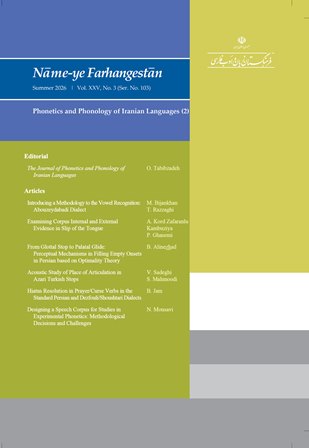
Examining Corpus Internal and External Evidence in Slip of the Tongue

Document Type : Original Article

Authors
1 Associate Professor, Department of Linguistics, Tarbiat Modares University, Tehran, Iran
2 Assistant Professor, Department of English, Islamic Azad University, Qazvin Branch, Iran
10.22034/nf.2026.573343.1510
Abstract
Sometimes words and phrases are purposefully combined and collocated with each other, and their phonological contexts have been considered. So that the density of the combination of similar sounds in a phrase or sentence exceeds the usual limit and slows down the speed of speech. On the other hand, the Persian speaker is asked to pronounce and produce such a phrase or sentence at a faster rate than usual. These two factors, namely the density of similar sounds and the increase in speed for the purpose of language game, cause the occurrence of language slips. The aim of this study is to examine these types of phrases and sentences in terms of phonology. For this purpose, 40 phrases that have tongue twister contexts were selected and several speakers of different genders and ages were asked to repeat them without interruption, and their pronunciation was phonologically recorded. Some of the results of this study are: 1. In corpus internal evidence, the association of morphemes and words is usually carried out with semantic, syntactic, or morphological goals. While in corpus external evidence such as the phenomenon of slips of the tongue, the association of words occurs with the aim of placing identical or similar phonemes next to each other, so that in terms of distinguishing characteristics they often belong to the same Natural Class. In this linguistic phenomenon, sometimes semantic structure, sometimes syntactic structure, and sometimes both are marginalized under the influence of the goals of the slip of the tongue game, and the field of phonology is often the focus of attention. 2. Contexts that are avoided in corpus internal evidence to observe the Obligatory Contour Principle (OCP) are deliberately placed next to each other in corpus external evidence such as slips of the tongue for the purpose of entertainment.
Keywords
Subjects

References
Sources are in Persian unless otherwise specified.
Boroughani, Fatemeh (2004, MA thesis), “A Phonological Study of Sabzevari Dialect”, Aliyeh Kord Zafaranlu Kambuziya (ed.), Tarbiat Modares University.
 Fallahi, Mohammad-Hadi (2007), “An Investigation of Different Types of Speech Errors in Adult Farsi Speakers”, Language and Linguistics, Vol. 3, No. 5 (S/N 5), pp. 127-136.
Fotouhi Roudma’jani, Mahmoud (2019), Stylistics: Theories, Approaches, and Methods, 4th print, Tehran, Sokhan.
Hyman, Larry M. (1989), Phonology: Theory and Analysis, trans. Yadollah Samareh, Tehran, Farhang Moaser Publishers.
Jam, Bashir (2017), “Features of Tongue Twisters and Analysis of Their Structure in Persian”, Journal of Researches in Linguistics, Vol. 9, No.2 (S/N 17), pp. 59-76.
Karimi Firouzjaei, Ali & Hanieh Yarmand (2019), “A Study of Spoonerism in Speech of 4-6 Years Old Persian-speaking Children: A Psycholinguistic Perspective”, Language Related Research, Vol. 10, No.2, pp. 225-250.
Kord Zafaranlu Kambuziya, Aliyeh (2018), Phonology: Rule-based Approaches, 7th print, Tehran, SAMT.
Zomorrodian, Reza (1989), A Study of Ghayeni Dialect, Mashhad, Astan-e Qods-e Razavi.
Volume 25, Issue 3 - Serial Number 103
Nameh Farhangestan (Phonetics and phonology of Iranian languages ​​2)
July and August 2026
Pages 31-45

  • Receive Date 03 February 2026
  • Revise Date 04 February 2026
  • Accept Date 08 February 2026